Hangul consists of 14 basic consonants and 10 basic vowels. Including 5 double consonants and 11 compound vowels, there are 40 letters.
By combining these letters into syllable blocks (gulja), Hangul can form 11,172 possible guljas. Once the consonants and vowels are learned, all guljas can be read without memorizing them individually.
Alphabet(Consonants and Vowels)
Basic Consonents
Consonant
Phonetic symbol
Corresponds to
As in
Consonant name
ㄱ
[g]
G
Golf
기역
ㄴ
[n]
N
New
니은
ㄷ
[d]
D
Delta
디귿
ㄹ
[ɹ] or [l]
R or L
Rich/Local
리을
ㅁ
[m]
M
March
미음
ㅂ
[b]
B
Bill
비읍
ㅅ
[s]
S
Study
시옷
ㅇ
[∅] or [ŋ]
- or ng
Artist
이응
ㅈ
[dʒ]
J
Jetty
지읒
ㅊ
[tʃ]
Ch
Church
치읓
ㅋ
[k]
K
Kelly
키읔
ㅌ
[t]
T
Taxi
티읕
ㅍ
[p]
P
Polar
피읖
ㅎ
[h]
H
Hotel
히읗
Double Consonant
Consonant
Phonetic symbol
Corresponds to
As in
Consonant name
ㄲ
[k͈]
GG
cognac, French
쌍기역
ㄸ
[t͈]
DD
Stop(AE)
쌍디귿
ㅃ
[p͈]
BB
Speak(AE)
쌍비읍
ㅆ
[s͈]
SS
Sorry(AE)
쌍시옷
ㅉ
[t͡ɕ͈]
JJ
Jazz(AE)
쌍지읒
Basic Vowels
Vowel
Phonetic symbol
Corresponds to
As in
Vowel Name
ㅏ
[a]
Ah
Art
아
ㅑ
[ja]
Ya
Yahoo
야
ㅓ
[ʌ]
Uh
Uncle
어
ㅕ
[jʌ]
Yeo
Yound
여
ㅗ
[o]
Oh
Oliver
오
ㅛ
[jo]
Yo
Yoga, Yoyo
요
ㅜ
[u]
Woo
Ultra, Wood
우
ㅠ
[ju]
Yoo
You, Utopia
유
ㅡ
[eu]
Eu
-
으
ㅣ
[i:],[I]
I
Illinois
이
Compound Vowels
Vowel
Phonetic symbol
Corresponds to
As in
Vowel Name
ㅔ
[e]
E
End, Exe-
에
ㅖ
[je]
Ye
Yellow
예
ㅐ
[æ]
Ae
Apple
애
ㅒ
[jæ]
Yae
Yanki
얘
ㅘ
[wa]
Wa
White
와
ㅙ
[oæ]
Wae
Wangler
왜
ㅚ
[we]
Oe
Way
외
ㅝ
[wʌ]
Ueo
War
워
ㅞ
[we]
Ue
Wafer
웨
ㅟ
[wi]
Wi
Willy
위
ㅢ
[ɰi]
Eui
-
의
Gulja Structure
What Gulja is
In Hangul, consonants and vowels are combined to create a single syllable. These sound units sometimes play a role and sometimes have meaning, and since there's no English word to express them, we'll use their Korean names, gulja, here.
Language
Alphabet (Consonants and Vowels)
gulja (Syllable Block)
Words
A Sentence
Korean
ㄱㄴㄷㄹㅁㅂㅅㅇㅈㅊㅋㅌㅍㅎ
ㅏㅑㅓㅕㅗㅛㅜㅠㅢ
여, 러, 분, 안, 녕
여러분,
안녕
여러분 안녕
English
B C D F G H J K...
A E I O U (YW)
-
Hello,
Everyone
Hello Everyone
In English, consonants and vowels form a word, and words form a sentence.
In Hangul, consonants and vowels form gulja, guljas form a word, and words form a sentence.
Gulja Shapes
Consonants and vowels are combined in the following ways. (C: consonant, V: vowel)
Consonant + Vowel Structure(CV) and the pronunciation
Consonant + Vowel + Consonant Structure(CVC) and the pronunciation
BTS Members’ Names in Hangul
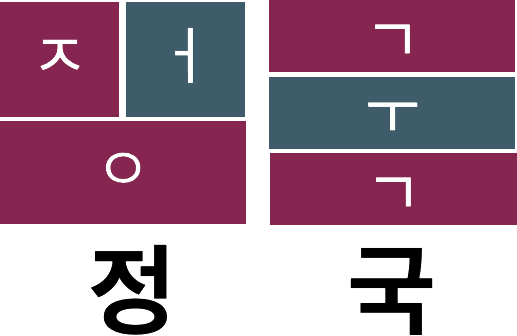
BTS Jungkook in Korean
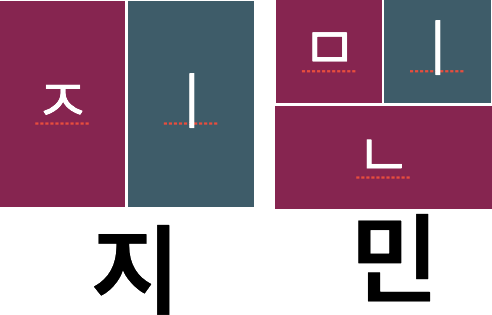
BTS Jimin in Korean
English Names in Korean
Jessica is 제시카, Sunny is 써니, Peter is 피터, George is 죠오지
How to write your name in Korean?
Sentence Structure
This page explains how English and Korean sentences are built, focusing on word order, particles, and verb endings.
1) Basic Word Order
English typically follows SVO (Subject–Verb–Object), while Korean typically follows SOV (Subject–Object–Verb).
Topic
English
Korean
Example (EN → KO)
Basic order
SVO
SOV
I eat an apple. → 나는 사과를 먹는다.
Verb position
Middle
Final
She likes coffee. → 그녀는 커피를 좋아한다.
2) Particles vs Prepositions
English often uses prepositions and fixed word order. Korean uses particles (e.g., 은/는, 이/가, 을/를, 에, 에서) to mark roles.
3) Flexibility of Word Order
Because particles mark roles, Korean can change word order for emphasis more freely than English.
4) Modifiers: Adjectives & Adverbs
Both languages usually place adjectives before nouns. In Korean, adverbs commonly appear before the verb.
5) Subject Omission
English usually requires an explicit subject. Korean often omits the subject when it is clear from context.
6) Tense & Aspect
English often changes the verb form and uses auxiliaries (be, have). Korean mainly uses verb stems plus endings (어미).
7) Sentence Endings & Politeness
Korean changes meaning and politeness level through sentence endings (e.g., -요, -습니다, -해요, -해).
Topic
English
Korean
Example
Role marking
Prepositions + order
Particles
to school → 학교에 / at school → 학교에서
Word order change
Limited
More flexible
I read a book. / (Emphasis) Book, I read. → 책을 나는 읽는다.